
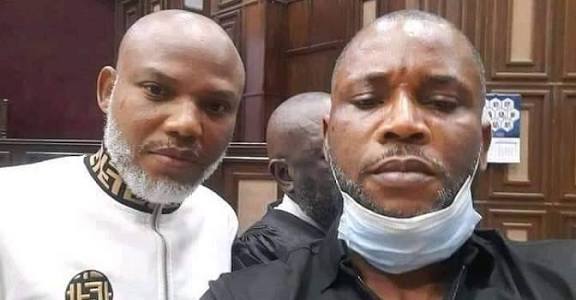
A Federal High Court in Abuja, on Thursday, halted an attempt by Emmanuel Kanu to appear for his elder brother, Nnamdi Kanu, in court.
The judge ruled that only a qualified lawyer can represent the detained leader of the proscribed Indigenous People of Biafra (IPOB).
Also, the court moved the hearing of a pending application seeking to transfer the convict from the Sokoto Correctional Facility to December 8.
Nnamdi Kanu, who was convicted on November 20, 2025, on seven terrorism charges and handed a life sentence, has remained in custody in Sokoto.
He was moved there shortly after the judgment, following the court’s concerns about recurring security breaches at the Kuje Correctional Centre.
Thursday’s sitting took a new turn when Emmanuel stood up in court and announced that he would represent the IPOB leader. The presiding judge, Justice James Omotosho, immediately stopped him.
The judge insisted that the law does not allow an ordinary citizen to appear for anyone in a criminal matter, stressing that only a licensed legal practitioner can move an application on behalf of a defendant or convict.
Justice Omotosho, addressing Emmanuel directly, explained that representation in court cannot be done by a relative, no matter the relationship.
He advised him to either hire a competent lawyer or seek assistance from the Legal Aid Council if he lacked the means.
The judge said the court would not consider the substance of the application until it is properly filed and moved by counsel.
Emmanuel then requested the next possible date, and the court fixed December 8, despite the judge stating that Monday was already heavy with cases.
The judge also issued a warning regarding public commentary on the case. He noted that one of Kanu’s former lawyers, later acting as a consultant, had claimed that the convict could not compile his appeal record unless he appeared physically in court.
Justice Omotosho dismissed this as misleading, saying the law does not require a convict to be physically present in court for the appeal record to be prepared.
He put the question before other lawyers in the courtroom, who unanimously agreed that Kanu’s presence was not a requirement for the compilation process.
The judge urged those speaking publicly on the matter to stop spreading incorrect interpretations of the law.
After refusing to take Emmanuel’s appearance, the judge adjourned the case to December 8 for proper hearing of the motion.
Kanu’s application, which he personally signed from custody, asks the court to order his transfer from the Sokoto facility to a correctional centre within the Abuja jurisdiction.
According to him, the distance—over 700 kilometres—makes it practically impossible for him to exercise his constitutional right to appeal his conviction.
He argued that preparing his appeal requires communication with the Federal High Court and the Court of Appeal in Abuja, as well as access to his relatives and consultants who all reside in the capital.
The judge also requested, in the alternative, that the court move him to Suleja or Keffi, both of which are near Abuja, so he can properly manage the appeal process.
Kanu’s motion listed several reasons why his current detention location poses hardship. He stated that he is currently without a legal team and plans to personally handle aspects of his appeal, which demands direct contact with court officials.
He added that leaving him in remote detention undermines his rights under Section 36 of the 1999 Constitution.
The court will consider all the issues when the matter comes up on December 8.
