
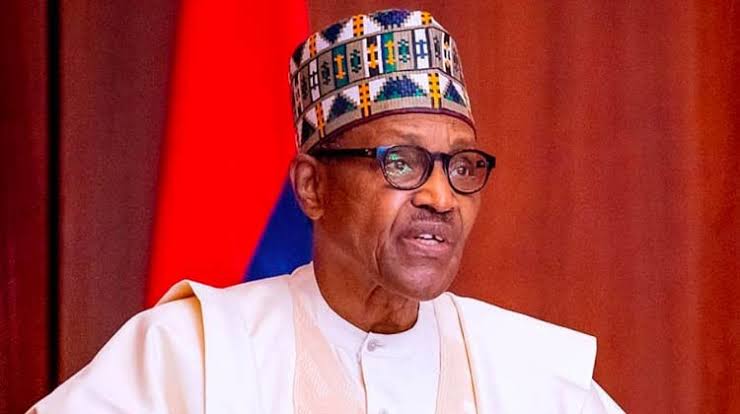
Fresh details have emerged on why former President Muhammadu Buhari refused to openly back a successor during the build-up to the 2022 presidential election.
The revelation is contained in a new book that examines Buhari’s leadership style, security philosophy, and handling of power within the All Progressives Congress (APC).
The book, titled “From Soldier to Statesman: The Legacy of Muhammadu Buhari,” was unveiled in Abuja and offers behind-the-scenes accounts of key decisions taken during Buhari’s time in office.
Written by Dr Charles Omole, the Director General of the Institute for Police and Security Policy Research (IPSPR), the 600-page publication brings together reflections from top officials who worked closely with the former president.
One of the most striking disclosures came from former Director General of the Department of State Services (DSS), Yusuf Bichi, who addressed the long-standing debate around Buhari’s refusal to anoint a preferred successor.
According to Bichi, Buhari deliberately avoided endorsing any aspirant during the APC presidential primary to protect lives and preserve internal party stability.
He explained that intelligence assessments at the time showed that openly backing a candidate could expose such a person to serious security threats in a tense and highly competitive political environment.
Bichi said Buhari’s silence was often misunderstood as indifference, but it was in fact a calculated decision driven by security concerns and a desire to prevent the ruling party from imploding.
He noted that the former president believed that publicly naming a successor would heighten rivalries, increase hostility, and potentially place the endorsed individual in physical danger.
“In those months, knives were out; politically and, as security professionals know too well, sometimes literally,” Bichi stated in the book.
He added that Buhari chose to absorb criticism rather than risk destabilising the party or endangering human life.
The former DSS chief said Buhari felt that allowing the primary process to play out freely helped distribute political risk among aspirants and prevented the concentration of hostility on one individual.
The book presentation attracted a high-profile audience at the Presidential Villa, including President Bola Ahmed Tinubu, Gambian President Adama Barrow, governors, ministers, diplomats, traditional rulers, and members of Buhari’s family.
President Tinubu eventually emerged winner of the APC primary and went on to secure victory at the general election, succeeding Buhari in office.
Beyond succession politics, the book also sheds light on Buhari’s approach to institutional authority, particularly his relationship with former Vice President Yemi Osinbajo.
Bichi revealed why Buhari refused to reverse Osinbajo’s decision to remove Lawal Daura as Director General of the DSS while Buhari was abroad on medical leave.
He said Buhari viewed any attempt to overturn the action as a threat to constitutional order and the legitimacy of the acting presidency.
According to Bichi, Buhari believed that once executive authority was lawfully transferred, it must be respected without interference.
He explained that Buhari saw a reversal as an insult to the office of the Vice President and a dangerous precedent for governance.
The book also disclosed that there was pressure from different quarters, including political allies, for Buhari to reinstate Daura upon his return.
However, Buhari stood his ground, choosing institutional discipline over personal loyalty.
Bichi further revealed that the removal of Daura was influenced by concerns raised by the former First Lady, Aisha Buhari, adding another layer to the episode.
He described Buhari as a leader who resisted ego-driven power struggles and refused to personalise governance, even under intense political pressure.
The former DSS boss also outlined Buhari’s broader security philosophy, portraying him as a president who prioritised evidence-based decision-making.
He said Buhari consistently demanded verifiable intelligence before approving arrests or security operations and was wary of acting on rumours or political influence.
Bichi noted that Buhari often asked security chiefs to provide proof, insisting that actions without evidence would not stand the test of law or public scrutiny.
This approach, he said, gave security agencies operational independence while holding them accountable for results.
The book also highlights Buhari’s personal discipline, frugality, and resistance to using state power against political opponents.
Bichi said the former president preferred targeting criminal networks rather than suppressing dissent, a stance that defined his leadership style.
