
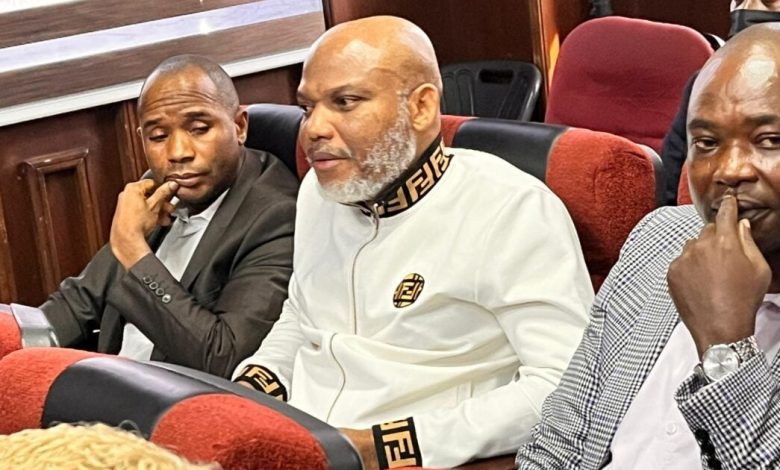
Mazi Nnamdi Kanu, leader of the Indigenous People of Biafra (IPOB), has sent a Christmas message from the Sokoto correctional centre, where he is serving a life sentence for terrorism-related offences.
In a statement issued by Prince Emmanuel Kanu, the IPOB leader’s brother, Kanu wished “all men and women of good conscience” a Merry Christmas.
The statement said Kanu also expressed gratitude to supporters for their prayers and goodwill during the festive season and beyond.
Meanwhile, Njoku Jude Njoku, one of Kanu’s lawyers, has continued to challenge the judgment delivered by James Omotosho, judge of the federal high court.
He described the conviction as predetermined and outcome-driven.
According to the lawyer, the most troubling aspect of the judgment was not merely its conclusion but the alleged suppression of evidence already admitted by the court.
He said the failure to evaluate such evidence reduced the adjudicatory process to what he described as a procedural façade.
“This was not an error of law or an oversight of fact; it was a calculated refusal to engage with material evidence whose evaluation would have fatally undermined the prosecution’s narrative,” Njoku said.
He added that once evidence is admitted, a judge is legally bound to evaluate it irrespective of the conduct or silence of the defendant.
“Judgment writing is not a negotiation with the accused; it is a solitary judicial duty anchored exclusively to the evidentiary record,” he said.
Njoku said while a court may reject defence evidence, it must first confront and assess it, warning that silence amounts to suppression rather than neutrality.
Njoku also criticised international media organisations for what he described as silence over the evidentiary issues raised by the defence.
He said by reproducing the conclusions of the judgment without interrogating its omissions, the media risk becoming accomplices in what he termed the laundering of judicial misconduct.
