US Lobby Firm Revives Tinubu’s Drug Case, Tables It Before Trump’s Govt
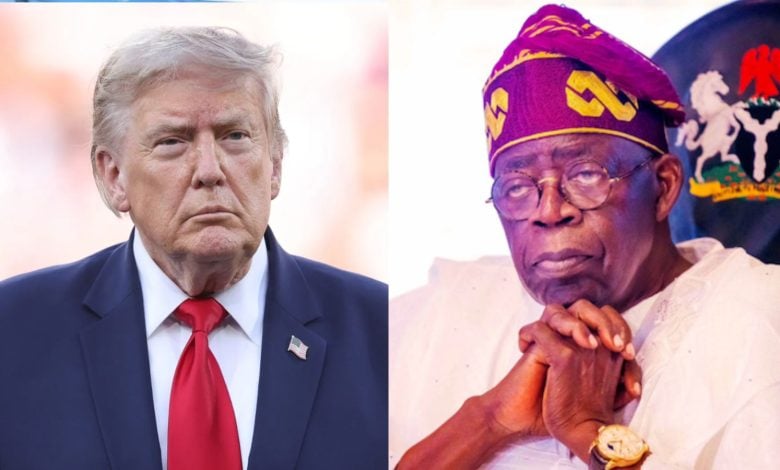
A United States-based lobbying firm has revived attention on a decades-old civil forfeiture case involving President Bola Tinubu, saying it has started circulating documents linked to the matter to officials in the administration of President Donald Trump and members of the US Congress.
The Washington lobbying company, Von Batten-Montague-York L.C., said the move forms part of its engagement with senior American government officials on issues relating to Nigeria.
The firm disclosed that it had begun distributing more than 60 pages of documents from the United States Department of Justice (DOJ), including court filings, affidavits and judicial decisions connected to the old civil forfeiture proceedings.
According to the company, the documents are being shared with officials in the executive arm of government, lawmakers and senior congressional aides to draw attention to allegations contained in historical US court records relating to Tinubu.
In a statement posted on X, the lobbying firm claimed some officials in Washington were previously unaware of the case and its legal history.
It wrote: “Following discussions with members of the @realDonaldTrump Administration, Congress, and senior congressional staff, we began providing more than 60 pages of @TheJusticeDept documents concerning the DOJ’s allegations of Nigerian President Bola Ahmed Tinubu’s alleged involvement in a heroin trafficking investigation spanning the late 1980s and early 1990s.”
The firm added that its objective was to ensure that relevant court records and legal decisions were available to key officials involved in US foreign policy and legislative oversight.
Von Batten-Montague-York was reportedly engaged in March 2026 under a one-year lobbying agreement linked to former Vice President Atiku Abubakar.
The contract covers strategic advisory services, engagement with the US executive and legislative arms, and efforts aimed at countering narratives promoted by the Nigerian government.
Details of the Historical Case
The lobbying company also circulated a document outlining the background of the 1993 US Department of Justice civil forfeiture case and the ongoing Freedom of Information Act (FOIA) litigation relating to records connected with the investigation.
According to the historical court filings, US investigators examined the activities of a heroin distribution network that allegedly operated in Chicago between 1988 and 1991.
The filings alleged that proceeds connected to the organisation were deposited into bank accounts owned or controlled by Tinubu.
The case also mentioned Adegboyega Mueez Akande and Abiodun Agbele in connection with the funds targeted by US authorities.
Court documents cited by the lobbying firm alleged that Akande was identified by investigators as a leader of the organisation and someone known to Tinubu. The records further claimed that Akande provided funds used to open one of the bank accounts linked to the Nigerian leader.
Agbele was also identified in the filings as an associate introduced to Tinubu through Akande. Investigators alleged that Agbele was arrested after selling heroin to an undercover law enforcement officer and later cooperated with authorities during the investigation.
Based on the investigation, the US government filed a civil forfeiture action before the District Court for the Northern District of Illinois in 1993, seeking the seizure of funds it believed were connected to drug trafficking or money laundering.
The matter was eventually resolved through a negotiated civil settlement in which 460,000 dollars was forfeited to the US government.
However, the proceedings remained a civil action against the funds and not a criminal prosecution against Tinubu.
The historical case did not result in a criminal conviction, and Tinubu was never charged with any criminal offence arising from the investigation. The Nigerian President has consistently denied any wrongdoing.
FOIA Case and Presidency’s silence
The lobbying firm’s document also referred to the ongoing Freedom of Information Act lawsuit filed in 2023 by American journalist Aaron Greenspan.
Greenspan had approached US courts seeking access to additional records relating to the old investigation.
In 2025, a US judge ruled that the Federal Bureau of Investigation (FBI) and the Drug Enforcement Administration (DEA) could not continue to rely entirely on a blanket refusal to confirm or deny the existence of certain records since aspects of the investigation had already been officially acknowledged.
The court directed the agencies to process relevant portions of the request in line with the Freedom of Information Act, although the litigation is yet to be concluded.
Von Batten-Montague-York said it is forwarding the chronology of the case and related court decisions to selected committees in both the US House of Representatives and Senate for what it described as “informational and oversight purposes.”
The firm also linked the renewed campaign to Nigeria’s strategic relationship with the United States and reports that President Tinubu is seeking a meeting with President Trump during the forthcoming United Nations General Assembly.
As of the time this report was filed, the Presidency had not publicly responded to the latest claims made by the lobbying company.
Verdict of the Tribunal on the Forfeiture Case
Recall, Tinubu’s US civil forfeiture records became one of the major issues raised after the 2023 presidential election.
Politics Nigeria earlier reported that Former Vice President Atiku Abubakar and Labour Party presidential candidate Peter Obi argued before the Presidential Election Petition Court that the forfeiture should have disqualified Tinubu from contesting the election.
The tribunal, however, dismissed the argument, holding that the petitioners failed to establish that Tinubu had been convicted of any criminal offence in the United States.
The court ruled that the proceedings relied upon by the petitioners were civil in nature and did not amount to a criminal conviction.
It also found that the evidence presented did not prove that Tinubu submitted false information to the Independent National Electoral Commission (INEC) by failing to disclose the forfeiture proceedings.