Fresh Tension in Rivers as Fubara, Lawmakers Disagree Over ₦1.854tn Budget
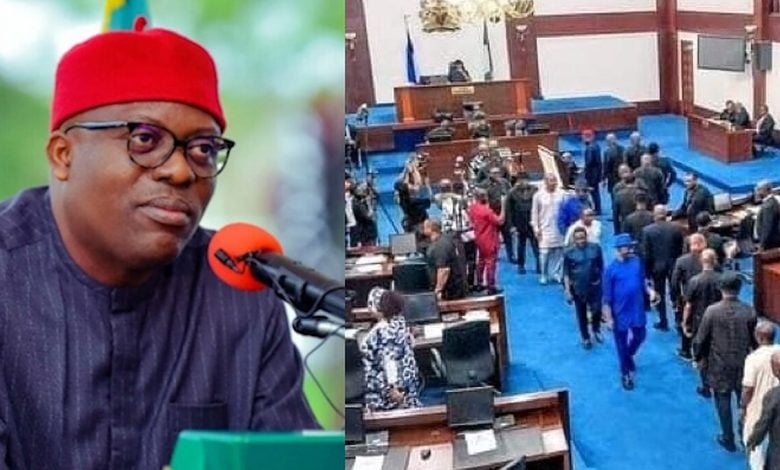
Fresh tension has emerged in Rivers State over the delayed passage of the proposed ₦1.854 trillion 2026 budget presented by Governor Siminalayi Fubara to the Martin Amaewhule-led House of Assembly.
The budget, titled the “Budget of Resilience for Growth and Development,” was presented by Fubara on July 10, 2026.
More than a month after the presentation, the appropriation bill is yet to receive legislative approval.
This has raise fresh questions about the relationship between the governor and the lawmakers despite the political reconciliation that brought the two sides together.
Fubara’s appearance before the Amaewhule-led Assembly was his first since the political crisis between the governor and the lawmakers erupted in 2023.
The presentation followed the Assembly’s approval of the state’s 2026–2028 Medium-Term Expenditure Framework, which had earlier faced delays.
The proposed budget provides for total expenditure of ₦1.854 trillion. About ₦413.1 billion is earmarked for recurrent expenditure, while approximately ₦1.405 trillion is planned for capital projects.
The capital component covers areas including infrastructure, education, healthcare, economic development and other government programmes.
However, the passage of the bill has not moved at the pace many expected after the governor and the lawmakers publicly embraced reconciliation.
A source familiar with the matter claimed that the governor met with the lawmakers over the proposed appropriation bill and reached agreements with them as part of efforts to settle outstanding political issues.
“To resolve the lingering political crisis, the governor met with the lawmakers on his 2026 appropriation bill. They had an agreement, and the deal paved the way for the lawmakers to allow the governor to present his appropriation bill,” the source said.
“But the governor has not been able to fulfil the agreements.”
The source alleged that some of the outstanding matters involve lawmakers’ benefits, entitlements and constituency-related projects.
“The governor has not done anything for them since assuming office, and I think they expect him to pay most of their outstanding benefits, and he agreed to do so, but hasn’t kept to his promise,” the source alleged.
The claims have not been independently verified.
This latest disagreement has also brought back concerns about the fragile nature of the reconciliation between the executive and the legislature.
The Rivers political crisis has remained closely connected to the relationship between Fubara and his predecessor, Nyesom Wike, who is now the Minister of the Federal Capital Territory.
Wike recently spoke about the delay in the passage of the budget and suggested that the reconciliation process had not completely resolved the disagreements between the governor and the lawmakers.
“The issue of budget, I know why you asked because you expected that once the budget is presented today, it will be passed tomorrow,” Wike said.
“Remember it won’t be that easy. But at the end of the day, the budget will be passed.”
The former governor also alleged that Fubara had failed to meet several commitments reportedly reached during the peace process.
“I will tell you totally that the governor has failed 90 per cent of what they all agreed on,” he said.
Wike further alleged that funds meant for the State House of Assembly Service Commission had not been released and that other benefits agreed upon had also remained outstanding.
A separate source claimed that mistrust remains a major factor behind the delay.
“The House of Assembly does not trust the governor because of a series of broken promises and unfulfilled agreements,” the source said.
“So, in any new agreement, they want the governor to satisfy his own side of the bargain first.”
The delay is also coming at a time when the state has a limited period left to implement the 2026 spending plan.
The late submission of the budget had already attracted criticism from the Assembly.
In June, Amaewhule faulted the governor over the delayed submission of the 2026–2028 Medium-Term Expenditure Framework.
He said the framework should have been submitted much earlier under the Rivers State Fiscal Responsibility Law.
Despite the criticism, the lawmakers eventually considered and approved the MTEF, clearing the way for the governor to present the appropriation bill.
The budget presentation itself was regarded as an important development because it brought Fubara and the lawmakers into the same legislative setting after years of confrontation.
The Assembly had been operating from its quarters auditorium after the main legislative complex was damaged.
The budget was subsequently laid before lawmakers following a motion inviting the governor into the chamber.
Despite that progress, the current delay suggests that political differences may still be affecting legislative business in the state.
The issue also has implications for ongoing projects across Rivers.
With more than half of the year already gone, prolonged delay in approving the budget could reduce the time available for the government to execute projects and programmes contained in the spending plan.
The proposed capital expenditure of about ₦1.405 trillion makes the issue particularly important, as a large portion of the budget is expected to support infrastructure and other development projects.
Concerns have also been raised over allocations to the legislature. The proposed ₦41.4 billion allocation for the Rivers State House of Assembly has generated debate.
Some people have question the size of the provision while others argue that adequate funding is necessary for the legislature to discharge its constitutional responsibilities.
Meanwhile, stakeholders have called for greater clarity on the status of the appropriation bill.
Convener of the Rivers Peace Initiative, Obinna Ebogidi, said the people of the state should know where the budget process currently stands.
“I think the most important thing at this point is for Rivers people to have clarity on where the 2026 budget currently stands,” he said.
Ebogidi also warned that the delay could affect the implementation period available to the government.
“The concern is not about rushing the legislative process, but about ensuring that the process does not lose momentum, particularly because implementation time is already becoming limited,” he said.
He urged the political actors to separate governance from preparations for the 2027 elections.
“Those developments are part of politics and should be allowed to take their course. But irrespective of the political arrangements around 2027, the government must continue to function,” he added.
National President of the South-South Youths Initiative, Oscar Imeabe, also expressed concern over the situation.
“Budgets are the blueprint for development. Every day of delay is a day of delayed roads, schools, hospitals, and youth programmes,” he said.
Imeabe urged the lawmakers to give the bill prompt consideration and ensure that political disagreements do not further affect government activities.