
US DEA Reveals Why Tinubu-Related Drug Records Remain Secret
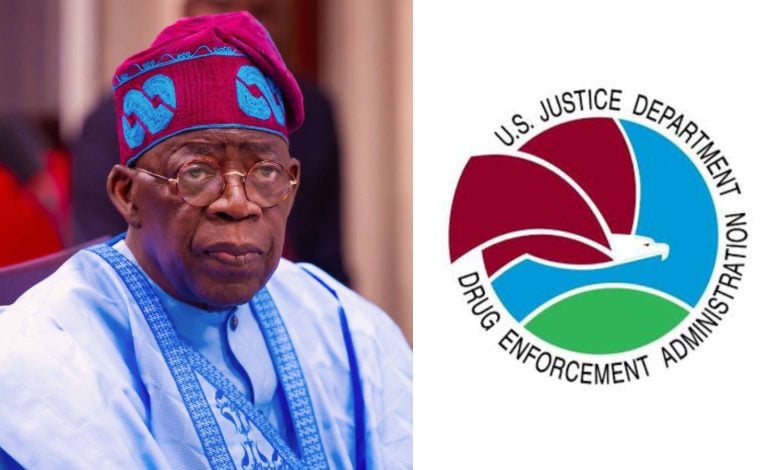
The United States Drug Enforcement Administration (DEA) has explained why parts of its investigative records connected to a long-running investigation involving President Bola Ahmed Tinubu remain withheld from public access.
The agency said the withheld portions contain information that could expose confidential sources, reveal non-public investigative methods and provide other sensitive details connected to law-enforcement activities.
Politics Nigeria gathered that the explanation was contained in a September 23, 2026 court filing by the United States government in an ongoing Freedom of Information Act (FOIA) case before the United States District Court for the District of Columbia.
The case was filed by American transparency activist Aaron Greenspan, who is seeking the release of historical records held by US federal agencies concerning investigations involving Tinubu and other individuals.
The case, Aaron Greenspan v. Executive Office for U.S. Attorneys et al., is a civil FOIA dispute over access to government records. It is not a criminal prosecution of Tinubu.
The latest filing was made as the US government defended the DEA’s decision to redact or withhold parts of the records sought by Greenspan.
According to the government, the DEA relied on declarations and a Vaughn Index to explain why particular portions of the documents could not be released under exemptions contained in the US FOIA law.
DEA Defends Withholding Of Investigative Records
The government said the DEA’s records include different types of investigative documents generated during law-enforcement activities.
Among them are DEA-6 Reports, DEA-292 Reports and DEA-210 Reports.
The plaintiff had questioned why several entries in the DEA’s Vaughn Index appeared to contain similar explanations for the withholding of information.
The government rejected the argument that the similarities made the index inadequate.
It explained that the documents belonged to similar categories of investigative records and therefore involved similar reasons for withholding information.
The government said the DEA had provided a declaration, identified in the case as the Davis Declaration, setting out the potential harm that could result from disclosure.
The declaration was also used to support the agency’s reliance on specific FOIA exemptions.
The latest court filing therefore provides more detail about the type of information contained in the records, although it does not reveal the substantive contents of the documents relating to Tinubu.
Confidential Sources
A major part of the DEA’s argument concerns confidential sources.
The government said the agency was entitled to protect information that could identify people who supplied information to investigators.
According to the DEA’s declaration, disclosure of such material could expose the identity of a confidential source.
The filing quoted the declaration as stating: “Any information related to confidential sources ‘could reasonably be expected to disclose the identity of a confidential source.’”
The DEA further argued that information concerning confidential sources receives extensive protection under the FOIA framework.
The agency said: “has long been afforded the most comprehensive protection of all the FOIA exemptions.”
The government also quoted the DEA’s explanation for refusing to release the information.
“Due to the significant protections afforded to prevent the disclosure of this type of information, DEA determined that the significance of exempting this type of information outweighed the relatively insignificant public interest in the disclosure of the information.”
The agency maintains that protecting those individuals is more important, under the applicable FOIA exemption, than releasing the information requested by Greenspan.
Investigative Methods Also Protected
The US government also defended the DEA’s reliance on FOIA Exemption 7(E).
That exemption covers certain law-enforcement records where disclosure could reveal investigative techniques and procedures that are not generally known to the public.
The filing said Greenspan had challenged the government’s handling of some of the withheld information.
It also referred to a sealed declaration submitted to the court concerning the investigative material.
The government maintained that the sensitive nature of the records justified the withholding of non-public investigative details.
The issue is particularly relevant because the documents arose from what the government described as “a criminal investigation of a drug operation.”
The government argued that releasing certain details could provide information about the methods used by law-enforcement agencies during the investigation.
The filing did not, however, provide details about what the investigators discovered during the investigation.
It also did not disclose the identity of any confidential source or reveal the contents of interviews, investigative reports or other material that remains protected.
How Tinubu Became Connected To The FOIA Case
The dispute dates back several years and centres on FOIA requests submitted by Greenspan to a number of US federal agencies.
The requests sought historical investigative records involving Tinubu, Nigerian businessman Abiodun Agbele and other individuals connected to an alleged drug-trafficking network investigated by US authorities.
The investigation dates to the late 1980s and early 1990s.
Tinubu’s name appears in the broader court proceedings because of records sought by Greenspan concerning the US investigation and a 1993 civil forfeiture proceeding involving money held in an account associated with Tinubu.

In April 2025, US District Judge Beryl Howell ruled that the FBI and DEA could not continue using a so-called “Glomar” response to refuse to confirm or deny the existence of records relating to Tinubu.
A Glomar response allows a US government agency, in certain circumstances, to refuse to confirm whether responsive records exist.
Judge Howell found that the existence of the relevant investigation had already been officially acknowledged and therefore the agencies could not rely on that response in the circumstances before the court.
The agencies were subsequently required to search for and process records that were not exempt from disclosure.
That process resulted in the release of records, while some portions remained redacted.





Now that the US government had supported the United States DEA’s non declaration of information contained in Tinubu’s file,what is the next step for Etiku and his collaborators in harm ?Over ambition kills more than anything.It is only GOD Almighty that bestows titles ,kingdoms and leadership to someone HE loves.Atiku should just forget about his ambition to become President of Nigeria.At least he is the President of AAUN,Yola.President is president.Same pronunciation,same spelling,same words.Tinubu till 2031,God willing.