‘Tinubu Must Stay’ Movement Launched Ahead of 2027 Election
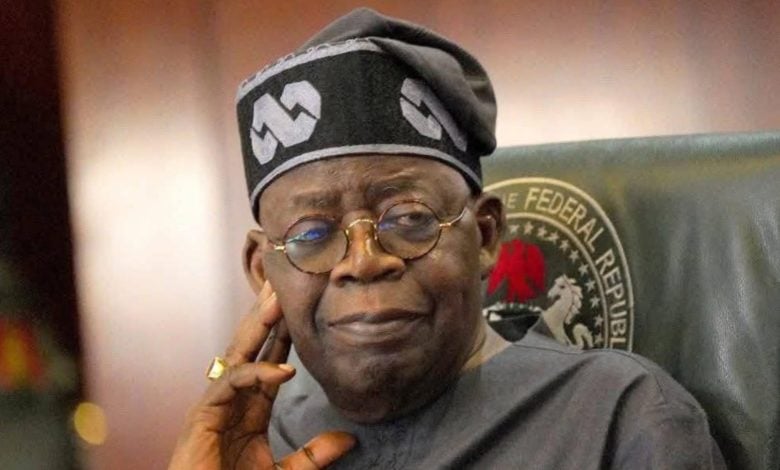
Tinubu Must Stay (TMS), a pro-government advocacy movement, has launched a national campaign calling for continued support for President Bola Ahmed Tinubu ahead of the 2027 general elections.
The movement unveiled its campaign as Nigeria marked its 66th Independence Anniversary, with its leadership saying it intends to take its message to citizens.
According to the movement, they will achieve this through fact-based communication, public engagement and discussion of the administration’s record.
The National Convener of TMS, Ibrahim Uba, made the position known during the group’s inaugural press briefing in Abuja.
Uba said the movement was formed by Nigerians who believe the policies introduced by the Tinubu administration should be examined based on available data and their long-term objectives.
He acknowledged that some of the government’s major economic decisions had created significant difficulties for Nigerians, particularly the removal of the petrol subsidy and reforms in the foreign exchange market.
He, however, argued that the hardship associated with the reforms should be considered alongside the government’s stated objectives and reported outcomes.
“When President Bola Ahmed Tinubu assumed office on May 29, 2023, Nigeria confronted serious fiscal, monetary, security and social pressures. His administration responded with major policy changes, including removing the petrol subsidy and implementing foreign-exchange reforms. Those measures have imposed substantial costs on households, with Nigerians experiencing higher living, transportation and energy costs,” Uba said.
“The challenges should neither be ignored nor understated. At the same time, public discussion should examine the administration’s full record—including measurable outcomes, unresolved problems and the longer-term objectives of its reforms.”
The movement said its campaign would focus on three major areas.
These include presenting what it described as fact-based counter-narratives, providing alternative explanations of government programmes based on available evidence and increasing civic engagement ahead of the 2027 elections.
Uba said TMS would seek to respond to criticisms of the administration while also encouraging Nigerians to examine government policies and their results.
He cited recent economic figures as part of the evidence the movement intends to place before the public.
Nigeria’s real Gross Domestic Product grew by 4.43 per cent year-on-year in the second quarter of 2026, compared with 4.23 per cent in the corresponding quarter of 2025 and 3.89 per cent in the first quarter of 2026.
The National Bureau of Statistics attributed the expansion to developments across major sectors of the economy.
Uba also pointed to the moderation in headline inflation reported in August 2026, while maintaining that economic statistics alone could not capture the experience of ordinary Nigerians.
“TMS recognises that statistics do not erase hardship and that government programmes should be assessed not merely by announcements or expenditure, but by their actual impact on citizens,” he noted.
“Our purpose is not to deny Nigeria’s difficulties. It is to ensure that public debate about those difficulties also recognises many documented positive interventions and allows competing claims to be tested against evidence.”
The group also highlighted education and social intervention programmes as areas it believes should form part of the discussion about the administration’s record.
Uba cited the Nigerian Education Loan Fund, NELFUND, saying more than 1.5 million students had benefited from the scheme, with over N282 billion reportedly disbursed.
The Tinubu administration introduced NELFUND as an interest-free student financing programme covering tuition support and upkeep assistance for eligible students.
Earlier reports in 2026 also showed that the scheme had expanded its reach to more than one million beneficiaries.
The TMS convener further mentioned the 3 Million Technical Talent programme, the National Health Fellows Programme and the NG-CARES intervention among initiatives he said should be considered when assessing the administration.
He said the 3MTT programme had trained more than 160,000 fellows across three cohorts, while the National Health Fellows Programme had been deployed across the 774 local government areas.
On social protection, Uba said the NG-CARES programme had reached more than 15 million vulnerable Nigerians.
Infrastructure also featured prominently in the movement’s presentation.
Uba listed projects such as the Lagos-Calabar Coastal Highway, Sokoto-Badagry Super Highway and Abuja-Kaduna-Zaria-Kano Road among ongoing federal projects.
He also referred to the Renewed Hope Housing Programme, under which he said more than 10,000 housing units had been delivered.
The movement had earlier highlighted similar infrastructure projects in its campaign activities, including the Sokoto-Badagry Super Highway and the Kano-Jigawa-Katsina-Maradi railway project.
The campaign also drew attention to the Federal Government’s efforts to promote compressed natural gas as an alternative fuel following the removal of petrol subsidy.
Uba said more than 120,000 vehicles had been converted to CNG, with 400 certified conversion centres and 90 refuelling stations supporting the programme.
He linked the initiative to the government’s broader efforts to reduce transportation costs and promote alternative energy sources.
Security remained another major issue raised at the briefing.
Uba admitted that insecurity continues to pose a major challenge to the country, while saying the government had intensified operations against terrorism, banditry, kidnapping, oil theft and other forms of violent crime.
“Security remains one of Nigeria’s most consequential challenges,” he said. “Operations against terrorism, banditry, kidnapping, oil theft and other violent crimes have been intensified, leading to significant improvement across the country. Progress in this sector must ultimately be judged by measurable improvements in the safety of communities, highways, farms and businesses.”
The launch of TMS adds another dimension to the growing political mobilisation ahead of the 2027 general elections.
Several groups have already begun organising around competing positions on Tinubu’s political future.
While TMS is campaigning for continuity, the separate “Tinubu Must Go” movement has also been active in demanding a change of government ahead of the next presidential election.
The TMS campaign, however, is presenting its case around the continuation of policies already introduced by the Tinubu administration.
Uba said the movement would not ask Nigerians to ignore the difficulties confronting the country.
Instead, he said citizens should consider both the challenges and the government’s reported interventions when forming their views about the 2027 election.
He maintained that stopping reforms before their intended outcomes are achieved could undermine the sacrifices already made by Nigerians.
“As Nigeria marks 66 years of Independence, TMS holds the view that reforms initiated over the past three years require continuity and further implementation to deliver their intended long-term outcomes. That is the case we intend to make for Nigerians—peacefully, factually and democratically,” he declared.