‘Stop Talking About What You Don’t Understand’ — Tinubu’s Aide Blasts Obi Over Fuel Price
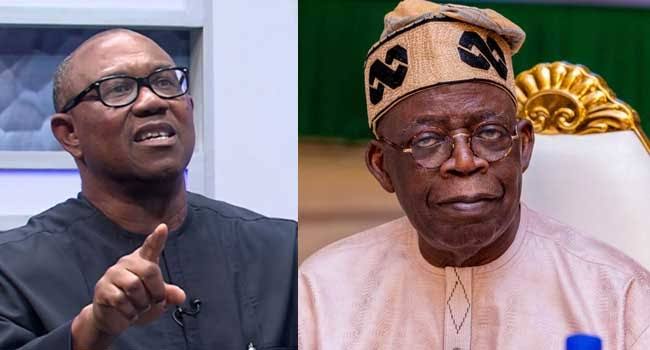
A presidential aide has sharply criticised the Labour Party’s 2023 presidential candidate, Peter Obi, over his recent remarks concerning the steady increase in fuel prices in Nigeria.
Dada Olusegun, Special Assistant to President Bola Tinubu on Social Media, said Obi’s comments on the issue were misleading and showed a poor understanding of how the current fuel pricing system operates.
The presidential aide warned the former Anambra State governor to desist from speaking on matters he does not fully grasp.

Olusegun reacted on Saturday through a post on X, responding to Obi’s earlier statement in which the former governor attributed the rise in petrol and diesel prices to Nigeria’s lack of a strategic petroleum reserve and poor government planning.
In the earlier remarks, Obi had expressed concern over the rising cost of petroleum products in the country. He noted that petrol, which sold for below ₦1,000 per litre only weeks ago, had climbed to over ₦1,200 per litre.
Diesel prices, according to him, had also surged from less than ₦1,000 to above ₦1,500 per litre. Obi linked the development to global oil market tensions, particularly those involving Iran.
“The reason for this is straightforward: most countries, whether they are oil-producing or non-oil-producing, maintain strategic petroleum reserves to cushion against supply or price shocks.
“This means that when there is a disruption in the global oil market, they can release part of these reserves to stabilize supply. However, Nigeria lacks such a buffer, so the impact is felt almost immediately.
“The underlying issue is a lack of planning. Countries that engage in planning create buffers against shocks, while those that do not remain vulnerable to them. The old maxim remains true: when a country fails to plan, it has already planned to fail,” Obi said.
However, Olusegun dismissed Obi’s position, insisting that the current increase in pump prices is largely a result of the deregulated nature of Nigeria’s fuel market following the removal of petrol subsidy by the Tinubu administration.
“The recent rise in fuel prices in Nigeria is not primarily because the country lacks a strategic petroleum reserve. The more immediate factor is that the fuel market is now largely deregulated following the subsidy removal by the administration of Bola Ahmed Tinubu,” he said.
According to him, in a deregulated system, fuel prices are influenced by several external factors, including global crude oil prices, exchange rates, shipping costs and supply risks.
“In a deregulated system, petrol prices respond directly to global oil prices, exchange rates, shipping costs, and supply risks.
“So when geopolitical tensions involving Iran push global oil prices upward, countries that rely heavily on imported refined products like Nigeria will inevitably feel the effect at the pump. That is simply how an open market behaves,” he explained.
The presidential aide also disputed Obi’s suggestion that strategic petroleum reserves are commonly used to stabilise everyday fuel prices.
“It is also not accurate to suggest that strategic petroleum reserves are tools used to control everyday pump prices.
“Even countries with very large reserves, such as the United States and China, maintain them primarily for serious supply emergencies, wars, embargoes, or major disruptions to global supply chains.
“They are not routinely deployed simply because prices move in the global market,” he said.
Olusegun further noted that Nigeria’s vulnerability to fuel price shocks stems largely from long-standing structural challenges, particularly the country’s dependence on imported refined petroleum products despite being a major crude oil producer.
“Nigeria’s real challenge has always been deeper and more structural. For decades, the country has struggled with limited refining capacity and a heavy dependence on imported refined products, despite being one of the world’s major crude oil producers.
“That structural imbalance, combined with exchange rate pressures, has consistently made the country vulnerable to global price movements,” he said.
He added that addressing the situation requires broader reforms rather than focusing solely on the absence of strategic reserves.
“So yes, planning matters. But reducing the entire issue to ‘Nigeria failed to plan because it does not have a strategic reserve’ completely misses the broader reality.
“Real planning would involve expanding domestic refining capacity, strengthening supply chains, stabilizing the foreign exchange environment, and maintaining consistent energy policies,” Olusegun said.
The presidential aide also reminded Obi that the former presidential candidate had, during the 2023 election campaign, publicly stated that he would remove fuel subsidy if elected president.
“It is worth reminding you that during your presidential campaign, you clearly stated that you would remove fuel subsidy if elected.
“So the same policy framework that now allows prices to reflect market realities is one you publicly supported,” he said.
Olusegun went further to question Obi’s understanding of the subject, describing the former governor’s comments as disappointing.
“When someone who once held the office of governor begins to make such sweeping conclusions about a complex global energy market, it is frankly embarrassing.
“A former governor should know better than to reduce a multi-layered economic issue to a simplistic talking point,” he said.
He also advised Obi to refrain from commenting on issues he does not fully understand.
“Sometimes the wiser thing to do is simply sit a conversation out when one does not fully understand how the system works rather than jumping at every opportunity to malign Nigeria, as this has been your modus operandi. It would save both the country and the speaker from unnecessary embarrassment,” Olusegun said.