Tinubu Seals Military Alliance with France to Tackle Terrorism in Nigeria
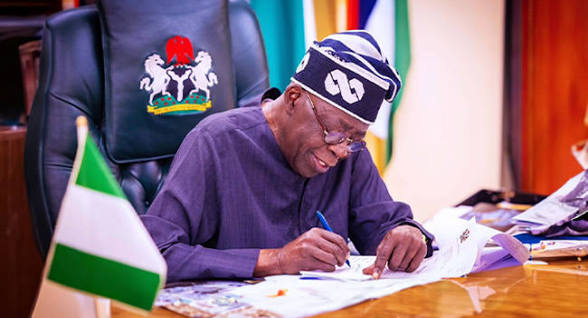
President Bola Tinubu has confirmed a new phase of military cooperation between Nigeria and France, aimed at strengthening the country’s fight against terrorism and rising insecurity.
The development follows high-level talks between Tinubu and French President Emmanuel Macron, as Nigeria intensifies efforts to secure external support for its armed forces.
The President made this known on Sunday during a meeting with state governors at his Ikoyi residence in Lagos.
The gathering took place shortly after his return from a two-day state visit to the United Kingdom, where security and defence partnerships also featured prominently in his engagements.
Speaking at the meeting, Tinubu said Nigeria had secured French backing in the area of military equipment and operational support.
He explained that discussions with Macron were extensive and focused on practical ways to boost Nigeria’s counter-terrorism capacity.
Tinubu noted that his administration is actively engaging other countries as part of a broader strategy to strengthen Nigeria’s security architecture.
He stressed that the government is prepared to utilise existing goodwill and financial arrangements to acquire the tools needed to confront violent threats.
The President described insecurity as a major test for his administration, warning that it poses a serious threat to national growth and stability. He urged governors to remain committed to joint efforts aimed at restoring peace across the country.
“The next phase of our struggle is staring us in the face; it is the challenge of insecurity in this country,” Tinubu said.
“I’m making all the efforts to ensure that collectively we share the joy and be proud of victory over tyranny.”
He stressed that insecurity continues to undermine development, economic progress, and social stability. According to him, state governments must play a critical role in supporting federal initiatives to defeat criminal elements.
Tinubu further revealed that military hardware acquisition was one of the key issues discussed during his recent visit to the United Kingdom.
He said the talks were centred on equipping Nigerian forces with modern tools to improve operational efficiency.
“One of the major discussions in the UK is equipment,” he said.
At the same meeting, the President also raised concerns about the economic impact of global tensions, particularly the ongoing crisis in the Middle East. He warned that the situation could trigger inflationary pressures and worsen the cost of living in Nigeria.
“I know this Middle East crisis will elicit inflation, will affect our purchasing power,” Tinubu stated.
“The labour union and others will be gathering to support them because of the effect of the Middle East War and prices at the pumps, resulting in transportation problems and food prices.”
The President thanked the governors for honouring his invitation on short notice. He described their presence as a sign of unity and shared commitment to addressing the country’s challenges.
Tinubu reiterated his administration’s resolve to invest heavily in modern technology and advanced equipment to combat terrorism and other forms of criminality.
“We must defeat terrorism and all of these criminal acts. As our investment in technology and equipment, we must defeat them,” he declared.
Nigeria continues to grapple with multiple security threats across different regions. Insurgency remains active in the North-East, while banditry and mass kidnappings persist in parts of the North-West and North-Central. Separatist tensions also linger in the South-East, adding to the country’s complex security landscape.
France, on its part, has maintained a long-standing military presence in parts of West Africa, particularly in the Sahel, where it has supported efforts to combat extremist groups exploiting weak governance structures.