REVEALED: How Boko Haram Stormed Military Base at Night and Killed General Braimah
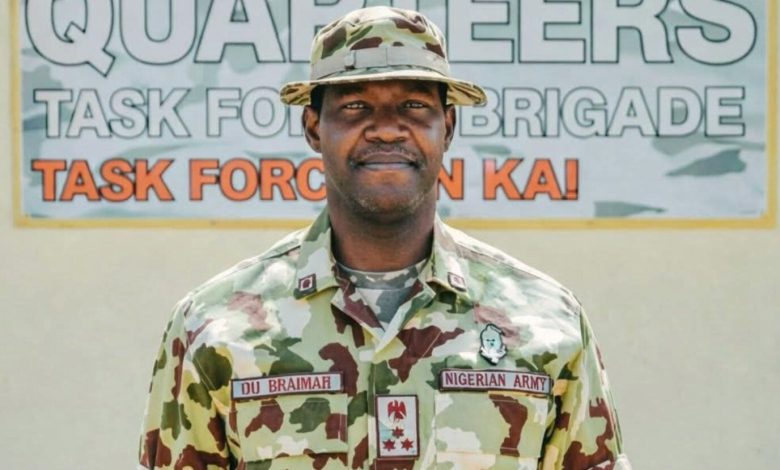
Fresh details have emerged on how insurgents carried out a deadly midnight attack on a military base in Benisheikh, Borno State, leading to the killing of Brigadier General Oseni Braimah.
The late officer was the Commander of the 29 Task Force Brigade before the assault that has now raised fresh concerns over security in the North-East.
The attack happened in the early hours of Thursday. It struck multiple military positions in the area. Survivors say the operation was well planned and executed with precision. It has been described as one of the fiercest encounters in recent months.
However, accounts from soldiers and residents suggest a more intense situation. The attackers were said to have overwhelmed troops and caused serious damage before withdrawing.
According to eyewitnesses, the insurgents moved in around 12:30am. They came in large numbers. They attacked from different directions at the same time. The town of Benisheikh, located along the Maiduguri-Damaturu highway, was thrown into chaos as gunfire and explosions filled the air.
Another soldier admitted that the attackers had a clear numerical advantage. “We stood our ground at first, but they were too many. They attacked from different angles. It was like an ambush,” he said.
As the battle continued, fear reportedly spread among troops. Information filtering in from other positions worsened the situation. Some soldiers began to lose confidence as rumours of casualties circulated.
“When we started hearing that our colleagues in other locations had been overrun, it shook us. Then someone shouted that the Brigade Commander was dead. That was when fear fully set in,” another survivor said.
Sources said the confusion affected coordination among troops. Some soldiers were forced to retreat towards nearby civilian areas for safety. The gun battle lasted for over one hour and 30 minutes, with several explosions recorded during the exchange.
After the attack, claims surfaced that General Braimah died due to a faulty Mine-Resistant Ambush Protected vehicle. But military insiders have rejected that narrative.
A senior source described the claim as inaccurate. “The insurgents actually set the MRAP on fire during the attack. Saying he died because the vehicle didn’t start is not accurate. The situation was far more complex,” the source said.
Another insider noted that only those present at the exact moment could give a full account. He added that many of them did not survive the attack. “I am aware that the insurgents closed in from various angles at the same time. It was like an ambush plan. But when the gun battle became intense, the terrorist formation scattered. What helped them was their numbers; there were too many of them,” he said.
A former driver to the late general also defended him. The man, identified as Blacky, spoke about Braimah’s attention to duty. “If you talk about maintenance, General Braimah doesn’t play with repairs. Ask anyone under the 29 Task Force,” he said.
He added, “I was General Braimah’s driver… It is not up to one week that I left the North-East.” He described the late commander as approachable and supportive to his men.
However, another source raised concerns about possible internal lapses. He suggested that issues around equipment maintenance may have existed before the attack. “If there was any failure, attention should go to those responsible for maintaining operational vehicles. There have been complaints before,” the source said.
The incident has again highlighted the persistent threat posed by insurgent groups in the region. It also raises fresh questions about operational readiness and troop safety in frontline areas.