
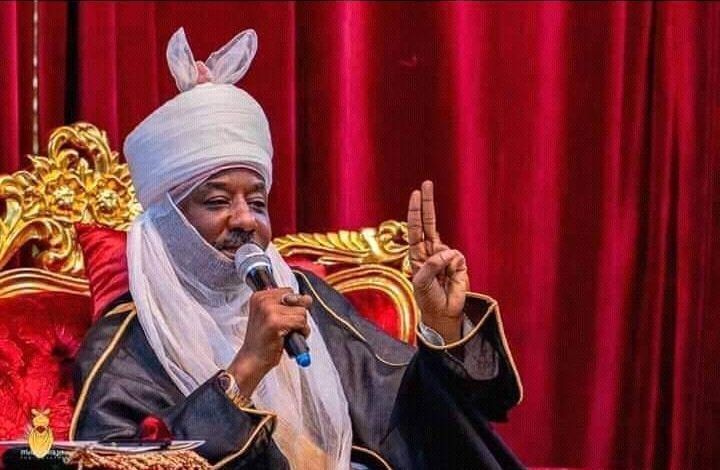
The Emir of Kano, Muhammadu Sanusi II, has taken aim at the Nigerian political elite, accusing them of deliberately obstructing the country’s progress for their own benefit.
He issued the strong warning while speaking at the 15th anniversary event of Enough is Enough (EiE) Nigeria in Lagos, where he described the current political culture as one that prioritises personal gain over genuine national advancement.
Sanusi said many office holders now treat public positions as private property, insisting that this attitude has remained one of the biggest obstacles to Nigeria’s development.
According to him, leaders routinely walk away from meaningful reforms because their focus is fixed on protecting narrow interests rather than improving the lives of citizens.
“We have done enough damage, and maybe we need to stop,” he said, adding that some of the opportunities wasted by the country are not accidental.
“These are not just missed opportunities, sometimes they are deliberately missed opportunities.”
The Emir explained that Nigeria’s ruling class often thinks first about themselves, their families, and their political circles, leaving governance — which should be about service — far behind.
He emphasised that public office is meant for the people, not a tool for enriching a few individuals or maintaining political networks.
He challenged young Nigerians to refuse the flawed system they met on ground and instead push for a country that reflects their aspirations.
Sanusi noted that the present order is shaped by years of ethnic politics, religious manipulation, and the pursuit of privilege by a select class.
“The nation belongs to us. It does not belong to the government or politicians,” he said. “Wherever we find ourselves, we are holding one small part of Nigeria, and we have a duty to contribute our quota.”
He urged youths across regions and backgrounds to unite and define the kind of nation they want to inherit.
According to him, Nigeria’s next phase must be one that breaks away from ethnic hostilities, religious divisions, rent-seeking, and the culture of mediocrity.
“It has to be a Nigeria that rises above ethnic rivalries, religious conflicts, and rent-seeking,” he said. “It has to be a country that finally realises its potential in the committee of nations.”
