
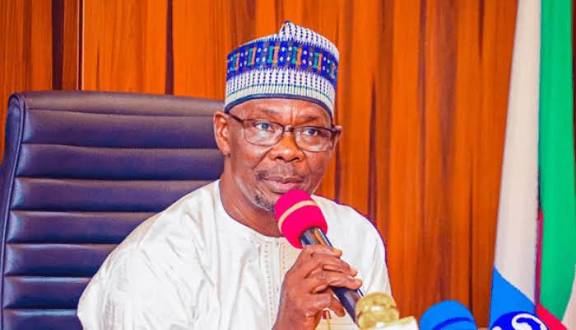
Nasarawa State Governor, Abdullahi Sule, has opened a fresh conversation on the root of Nigeria’s worsening kidnapping crisis, insisting that the crime did not originate in the northern region.
He said the issue has reached a point where no part of the country can pretend to be safe or uninvolved.
Governor Sule made the remarks during a live appearance on Sunday Politics, where he painted a stark picture of how deeply worried Nigerian governors have become over the country’s security problems.
According to him, the conversation at their last meeting was extremely tense, as many governors expressed frustration and fear over the rising wave of kidnappings nationwide.
He explained that Nigerians often forget past events too quickly, which makes it easier for people to cast blame on regions they assume are responsible.
“It is usually very forgetful for us in this part of the world, you know we usually forget things very, very easily and we are very fast actually and very quick in pointing accusing fingers at others,” Sule said.
The governor noted that the heated atmosphere at the meeting showed how desperate leaders have become.
He said emotions ran high as governors openly challenged themselves on what they were doing wrong.
“You needed to see the stress at that meeting and the tension during the meeting as far as the issues of these insecurities are concerned,” he said.
“Sometimes people raise their voices… people are angry, people are warning, people are thinking we are not doing enough. We are accusing ourselves that we are not doing enough.”
Sule stressed that such agitation is a sign that state leaders are extremely troubled by the situation. “If the people are not worried, we wouldn’t be talking like that to each other,” he added.
He also pushed back against the widespread belief that kidnapping started in the North. The governor traced the history of abductions to Nigeria’s oil-producing region long before the North became a major target.
“Let me remind you… if you go back between 2003, 2004 all the way to around 2009 in this country, no kidnapping was taking place in northern Nigeria,” he said. “But kidnappings were taking place in all the oil regions.”
Sule, who worked in the oil and gas industry for years, recalled how kidnappers frequently targeted foreign and local oil workers in the Niger Delta. He said the attacks became so common that they were seen as part of daily life in the industry.
According to him, several firms suffered repeated losses, including one incident involving Tetra Tech where staff members were taken hostage.
“One of them was kidnapped, and they made up their mind that they were not going to come back to Nigeria,” he said, explaining that the crisis forced him to operate for some time in Port Harcourt and Trans-Amadi.
He noted that the early wave of abductions in the South was driven primarily by financial motives.
Oil workers were seized, and companies were pressured into paying ransom to secure their release.
“It was mostly economic kidnapping because they kidnapped some of our people and a lot of them, in most cases oil workers, were kidnapped and oil companies would pay,” he explained.
The governor added that the situation only began to ease during former President Goodluck Jonathan’s administration after several negotiations aimed at calming tensions over resource control and militancy.
Sule warned Nigerians not to treat the present security crisis as a regional problem, saying that such divisions will only allow kidnappers to spread further.
“We forget that the issue of kidnapping started in the South with the abduction of oil workers, then the people of the North thought it was none of their business,” he said.
“Now it is a major problem in the North. All of us as Nigerians should work together to eradicate kidnapping from Nigeria.”
Despite the worrying situation, the governor believes the country will eventually overcome the menace.
“So now the kidnapping came into northern Nigeria; so this is what is happening and it will come to an end,” he said.

Young man, let me bring to your knowledge that what we had in the South South region then wasn’t terrorist. The people were being cheated by your notherners. Your people took our oil and enrich themselves. Without even minding that that is from the South. In your case tell me what your Boko Haram and terrorists are agitating for.
Only because of their selfish interest