
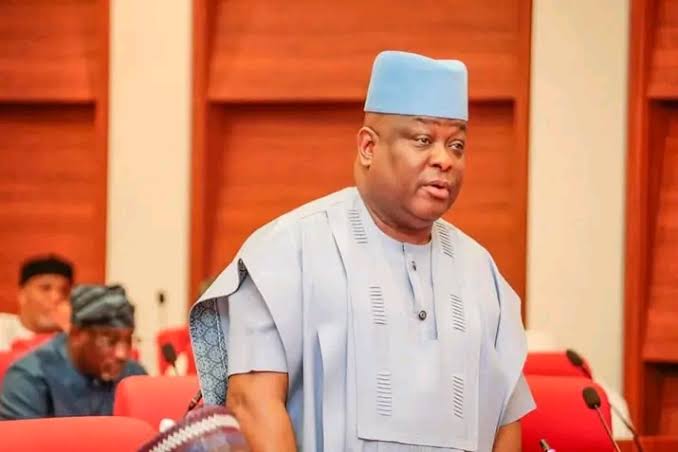
A senior lawmaker has warned that Nigeria is increasingly being governed by people who lack the training, discipline and mindset required for leadership.
The Senator said political office has been reduced to mere occupation of power, rather than a call to serve with competence and character.
The alarm was raised on Wednesday in Abuja by the Chairman of the Senate Committee on Capital Markets, Senator Osita Izunaso.
He spoke during the public presentation of Leadership 365: Daily Reflection for Effective Leadership, a new book written by Dr Linus Okorie, President of the GOTNI Leadership Centre.
Speaking before an audience of political leaders, professionals and leadership experts, the Imo West Senatorial District representative said many Nigerians wrongly assume that holding office automatically makes a person a leader.
According to him, this dangerous thinking has contributed to poor governance across the country.
Izunaso criticised what he described as the absence of deliberate leadership grooming in Nigeria. He said individuals often emerge into positions of authority without the values, discipline and conduct expected of leaders.
He warned that this trend continues to weaken public institutions and erode trust in governance.
“In this country, we do not train leaders. We just assemble people, and people start talking as if they are leaders. There must be a way leaders should talk. A leader doesn’t talk or walk anyhow because people are watching you.”
The lawmaker explained that leadership is not limited to political office holders. He said leadership can be seen in everyday life and often emerges naturally through character and responsibility, not by appointment or election alone.
“Dr Okorie has demonstrated deep thought and some leadership ideas in his book. Leadership is part of our everyday life. But oftentimes people misunderstood leadership to mean only those who occupy political positions, which is not correct.
“The fact that you occupy an office does not make you a leader. Most times leaders are born, most times leaders emerge. If you have 12 children in a class, watch them carefully. Watch their mannerism—the leader among them will emerge. Leadership is not about occupying a high position.”
Izunaso also used the platform to address Nigerian youths. He cautioned them against the growing obsession with quick wealth and flashy lifestyles. He urged young people to focus on character, discipline and mentorship, rather than money-driven success.
“For the younger ones coming up, do not embrace the culture of let’s get rich quickly. Rather, imbibe the culture of having role models. There must be someone you admire as a role model. Money shouldn’t be the motivation to make anybody your role model.”
In his remarks, the author of the book, Dr Linus Okorie, stressed that national development cannot be achieved through technology alone. He said progress depends largely on people who are intentionally groomed to lead with vision, courage and integrity.
“Progress evolves only when men and women of vision, skill and courage seize the opportunity to change things for the better. In the 21st century, I have been told that technology and AI are on the rise.
“But the truth of the matter is that there is nothing that will be as powerful as the human spirit. The human spirit, when properly channelled, can cause a change that could transform businesses, institutions and nations.”
Okorie said nations that have made lasting progress did so by investing heavily in leadership development. He noted that grooming future leaders should be a continuous and intentional process, not an afterthought.
“Today, there is nothing as powerful as grooming, intentionally, the next generation of leaders for any nation.
“Nations of the world that made great progress are the ones that invested heavily in the leadership capital of our citizens.”
He explained that Leadership 365 was written to encourage daily self-reflection on leadership and personal responsibility.
According to him, the book is designed for individuals who want to influence society positively, regardless of their position.
However, concerns about leadership quality have remained a recurring issue in Nigeria’s political space. Many citizens continue to blame weak governance, policy failures and institutional decay on the emergence of leaders chosen through wealth, connections and loyalty rather than competence.

IT IS AS IF THE COUNTRY IS UNDER A SPELL
Nigeria has gone backward by 50 years under APC ! If you know you know.