
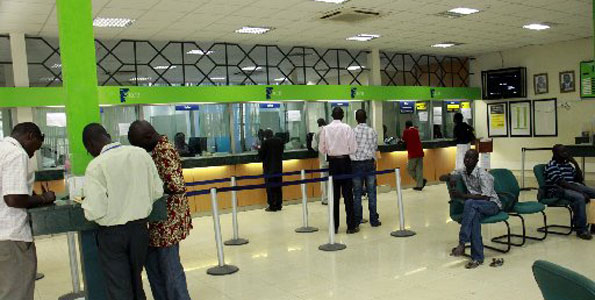
Nigeria’s banking industry shut 229 physical branches in one year as customers increasingly relied on point-of-sale (POS) terminals for daily transactions.
Data from the Central Bank of Nigeria 2024 financial sector statistical bulletin showed that deposit money bank branches declined from 5,373 in 2023 to 5,144 in 2024.
The statistics cover branches and cash centres of commercial, merchant and non-interest banks across the 36 states and the federal capital territory.
The data showed that although the number of licensed banks increased from 33 to 35 in 2024, the sector’s physical footprint continued to shrink.
The bulletin indicated that electronic payments, particularly POS transactions, expanded sharply during the period.
The volume of POS transactions rose from 9.85 billion in 2023 to 13.08 billion in 2024, which represents an increase of about 3.23 billion transactions, or roughly 33 percent year on year. The value of POS transactions more than doubled within the same period.
The figure increased from N110.35 trillion in 2023 to N223.27 trillion in 2024. ATM usage also grew, but at a significantly slower pace compared to POS channels, while ATM transaction volumes rose marginally from 1.01 billion to 1.02 billion transactions.
The value of ATM transactions increased from N28.21 trillion to N29.12 trillion, representing just over three percent growth.
The data shows that POS terminals have become more central to consumer payments than cash withdrawals or visits to banking halls.
Lagos state remained Nigeria’s banking hub with 1,521 branches in 2024. However, the state lost 11 branches compared to 1,532 recorded in 2023.
Ebonyi state recorded the largest decline, losing 89 branches in one year. The number of branches in the state fell from 120 in 2023 to 31 in 2024.
Oyo state lost 26 branches, while Niger state recorded a decline of 32 branches. Ekiti and Ondo states each lost 18 branches within the year. Anambra and Ogun states recorded eight branch closures each, while Cross River lost five and Plateau lost seven.
The Federal Capital Territory also lost nine branches, dropping from 400 in 2023 to 391 in 2024. Some states, however, recorded an increase in bank branches.
Delta state added six branches, while Rivers state gained eight. Edo, Kaduna and Kano states also recorded increases of eight branches each. Katsina added three branches, Adamawa and Jigawa gained two each, while Kogi recorded one additional branch.
The data suggests that branch expansion is increasingly driven by areas with growing commercial activity and population growth.
Financial analysts have linked the surge in POS usage to cash scarcity, the expansion of agent banking networks and the convenience of accessing financial services closer to homes and markets.
The trend persisted despite higher POS charges during periods of cash shortages. In December 2024, POS agents reportedly increased charges significantly as many bank ATMs remained empty.

We expect more branches to fold up to give more rooms to easy and fast financial transactions under minding the risk involved but time na money.