Supreme Court Dismisses Police Appeal, Upholds N10m Damages for Delta Residents
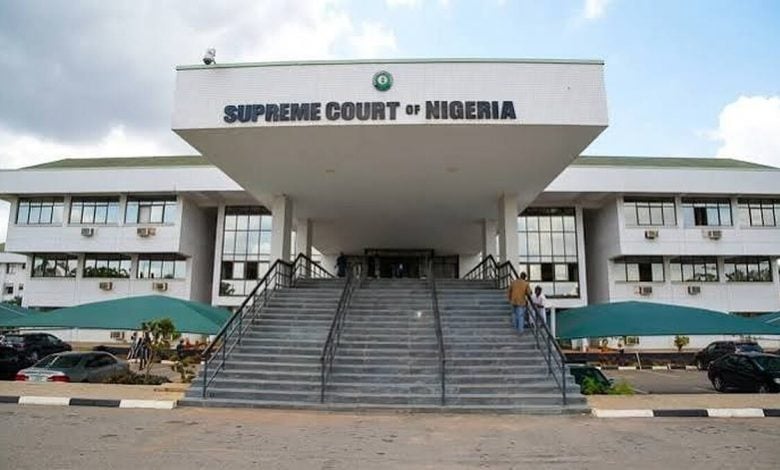
The Supreme Court has dismissed an appeal filed by the Nigeria Police Force challenging the judgment of the Court of Appeal, Asaba, which found the police liable for violating the fundamental rights of 14 residents of Delta State.
The appeals, marked SC/CV/833/2024 and SC/CV/834/2024, were instituted by the Commissioner of Police, Delta State; the Assistant Inspector-General of Police, Zone 5; and the Inspector-General of Police against the affected residents, including Sunday Mbam, Jennifer Ogborgu and Ernest Ezenem.
The respondents had alleged that they were unlawfully arrested and detained during a controversial police operation in communities within the Kwale axis of Delta State.
In a majority judgment delivered on Friday, Justice Abubakar Sadiq upheld the earlier decisions of the Federal High Court and the Court of Appeal, affirming that the police violated the respondents’ constitutional right to personal liberty.
The apex court also upheld the Court of Appeal’s award of N10 million in aggravated and exemplary damages, as well as N500,000 in costs against the police authorities.
Justice Sadiq held that the right to personal liberty, as guaranteed under Section 35 of the 1999 Constitution, is one of the most fundamental rights protected by law and that the courts have a duty to guard citizens against abuse of state power.
“The fundamental right to personal liberty is one of the cornerstones of human rights and a bedrock principle in any society governed by the rule of law,” the justice said.
The court found that evidence before it, including an interview granted by a police spokesperson and published in The Pointer newspaper, established that police officers conducted the operation in the Kwale axis at the time in question.
It rejected the police’s argument that the respondents’ communities were outside the area covered by the operation, holding that the communities formed part of the Kwale axis where the raid took place.
The Supreme Court further ruled that the police failed to rebut the allegations that the respondents were unlawfully arrested and detained during the operation.
The court also dismissed the police’s contention that the Court of Appeal lacked the power to award damages because the respondents did not file a cross-appeal.
Justice Sadiq held that the appellate court validly exercised its powers under Section 15 of the Court of Appeal Act, relying on the legal principle of ubi jus ibi remedium—where there is a right, there is a remedy.
“Where a legal right is violated, the law provides a remedy either in damages or other appropriate relief,” he said.
Concluding the judgment, Justice Sadiq said there was no merit in the appeal and affirmed the judgment of the lower court.
“Having resolved both issues against the appellant, it is obvious that there is no merit in this appeal. I dismiss the appeal and affirm the judgment of the lower court,” he ruled.
The police had argued that there was no direct evidence linking them to the alleged unlawful raid and that the lower courts relied on speculation and a newspaper publication rather than credible evidence.
Counsel for the appellants, Dr Richard Ishiguzo of the Directorate of Legal Services, Delta State Police Command, maintained that the police interview relied upon did not specifically mention the respondents’ communities or establish that officers carried out any unlawful operation there.
However, the Supreme Court disagreed, holding that the evidence presented justified both the finding of rights violations and the award of damages.
Justice Adhumien, in a dissenting judgment, disagreed with the majority decision and held that the appeal should have been decided in favour of the police authorities.