“Atiku Funded My Impeachment Plot With ₦5m” — Obasanjo Reveals
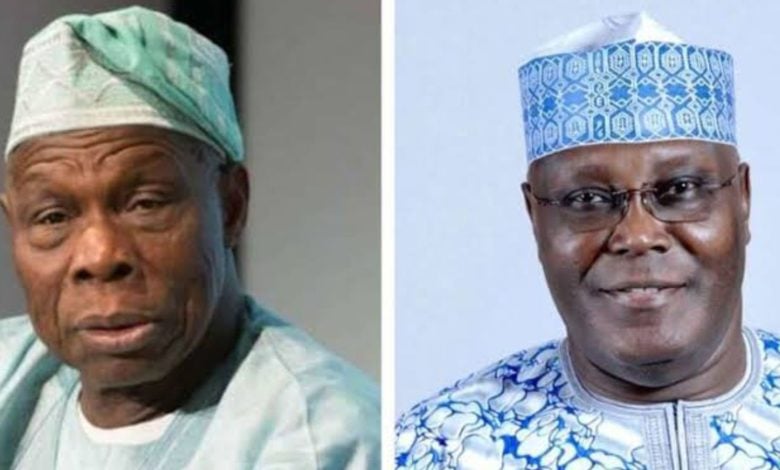
Former President Olusegun Obasanjo has accused former Vice-President Atiku Abubakar of backing an impeachment move against him during his first term in office, alleging that ₦5 million was provided to kick-start the plot.
Obasanjo made the claim while responding to former Ogun State Governor, Chief Olusegun Osoba, over comments relating to the political events that led to the 2003 general elections.
In a detailed statement titled, “Reply to Your Inaccurate Posture: ‘How Obasanjo Deceived Us in 2003’,” the former President rejected Osoba’s allegation that he misled leaders of the Alliance for Democracy (AD) and Afenifere ahead of the election.
The former Nigerian leader described Osoba’s account as inaccurate and incomplete, insisting that he never deceived anyone during the political negotiations that took place before the 2003 polls.
“I take strong and serious objection to your calling me a deceiver because I deceived nobody.
“I always presented my case and all issues as I had them and as I understood them, no matter whose ox is gored,” Obasanjo stated.
He argued that several discussions that shaped political decisions at the time were handled by senior figures within Afenifere and the AD, adding that Osoba was not involved in many of those engagements.
According to Obasanjo, some of the decisions and consultations that influenced the political landscape before the elections took place at levels beyond the knowledge of many party members.
The former President also revisited the impeachment threat that confronted his administration during his first term.
He alleged that the late Speaker of the House of Representatives, Ghali Na’Abba, was encouraged to commence impeachment proceedings after a meeting with Atiku.
“Na’Abba’s impeachment began at the presidency by the Vice-President, who on a Friday when I was out of the office, invited Na’Abba to his office and convinced him, as he had convinced himself and some others but of insignificant number, that I should have only one term as President,” Obasanjo claimed.
He further alleged that financial support was provided to facilitate the process.
“On the Friday, he invited Na’Abba; he gave him N5 million to begin his impeachment work. It was all noted, recorded and reported to me by my Chief of Staff, a professional intelligence officer,” he said.
Obasanjo stated that he was not troubled by the impeachment threat because he believed there was no constitutional basis for removing him from office.
“The game continued to be played on with me treating it with contempt as I have committed no impeachable offence except my Vice-President who wanted to take over by hook or by crook,” he added.
The former President further alleged that after the impeachment effort failed, another political arrangement was pursued ahead of the 2003 elections.
According to him, a plan was promoted to ensure that the six AD governors in the South-West would face little or no political opposition during the elections, with an understanding that support would later be given to Atiku’s presidential ambition in 2007.
“When he failed in the impeachment exercise, he made a two-track approach: one to go with Alex Ekwueme and Alex to hand over to him in the third year of his presidency; second is for the six AD governors of South-West not to have competition from any other party in 2003 so that in 2007, you would all yield the field to my Vice-President,” Obasanjo alleged.
He maintained that claims linking him to such an arrangement were false.
“You were all convinced of this anti-democratic plan, and you all fell for it. I was told that I was said to be selling the idea, and if that was said of me, it was a lie,” he said.
Obasanjo also defended the outcome of the 2003 governorship elections in the South-West, where the Peoples Democratic Party (PDP) displaced most of the AD governors.
He insisted that the results largely reflected the wishes of voters, although he alleged that figures were altered in one state.
“Your loss or defeat in 2003 was genuine in all the six states except the one where the figures were successfully and murderously changed,” he stated.
The former President further claimed that Osoba did not campaign vigorously before the election and later attempted to explain public perceptions about his leadership style.
“From information that reached me from the political field, you barely campaigned, and at the tail end of the campaign, you went on TV to apologise to the people for your arrogance and informed them that the starch in your agbada caused your arrogant appearance,” Obasanjo said.
Reflecting on his return to politics after his release from prison, Obasanjo disclosed that he initially had no intention of seeking public office.
He said he planned to focus on his family and personal affairs before delegations from different parts of the country persuaded him to return to national politics.
He noted that consultations with political leaders across Nigeria eventually influenced his decision to join the PDP and contest the presidency.
Obasanjo also defended his decision to appoint politicians associated with the AD into his administration after taking office in 1999.
According to him, the move was aimed at fostering national unity and bringing the South-West closer to the centre of national governance.
“Bringing PDP and AD to join me for a sort of national government was not out of weakness; rather, it was out of strength and the unity and progress of the country,” he said.
The former President dismissed suggestions that the six AD governors had sufficient influence to dictate terms to his administration, arguing that he already enjoyed support from a majority of governors, the National Assembly and key institutions of government.
“Six to dictate to thirty is ridiculous. I had an Executive Council, I had a National Assembly, I had a virile political party, 21 governors and nine other governors from another party with my government,” he stated.
Despite the sharp exchange, Obasanjo acknowledged Osoba’s role in allocating the land on which the Olusegun Obasanjo Presidential Library was built in Abeokuta.
He described the gesture as one of the most significant contributions made by the former governor and urged political leaders to preserve relationships despite disagreements.
“It is not over until it is over and there is no end to humility and thanksgiving.
“In politics, no one should be ignored or disregarded, and politics may end, relationships may live till life’s end,” Obasanjo said.