Trump Declares Strait of Hormuz ‘New US Territory’ Amid Iran Conflict
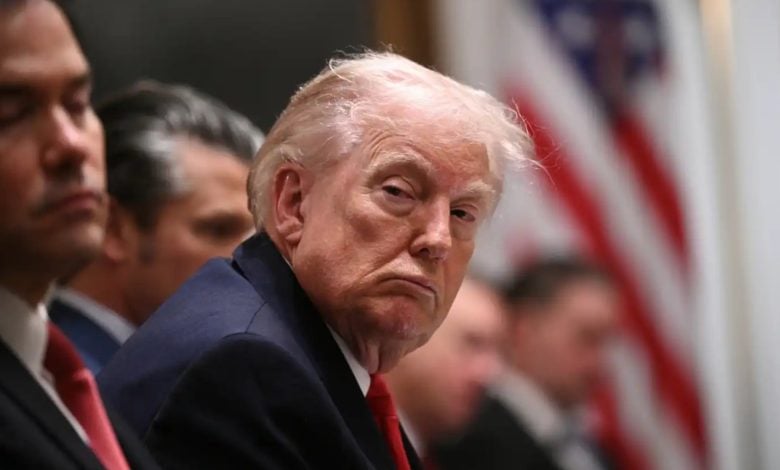
US President Donald Trump has intensified his confrontation with Iran after sharing a map that labels the strategically important Strait of Hormuz as a “NEW U.S. Territory”.
Trump posted the graphic on Truth Social on Tuesday, August 18, 2026, amid the continuing dispute between Washington and Tehran over control and access to the waterway.
The same image was later shared by the official White House account on X, giving the controversial map further prominence.
The graphic highlights the Strait of Hormuz in blue and places a circle around the narrow maritime passage. The words “NEW U.S. Territory” appear across the map.
Trump’s post comes days after he claimed that the United States had established control over the waterway through its military presence in the region.
Trump had previously threatened to make a permanent US claim over the strategic passage once the conflict with Iran was brought to an end.
Speaking at a political event in New York State last Friday, Trump said, “After we finish defeating Iran, which is being very badly defeated — pretty soon I’ll be declaring the Hormuz Strait a territory of the United States.”
“It’s true,” he added.
Trump also described the proposal as “a great idea” and “an excellent idea”.
His argument has centred on the role played by the US military in securing shipping through the region.
Washington has maintained a naval blockade against Iran as part of its pressure campaign.
Trump had earlier declared that, “We have the blockade. No ships get through unless we want them to.”
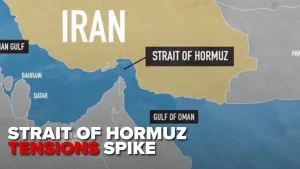
The Strait of Hormuz is located between Iran and Oman and connects the Persian Gulf with the Gulf of Oman and the wider Arabian Sea.
Its importance extends far beyond the immediate US-Iran conflict.
The waterway is one of the world’s major energy routes. A significant share of global crude oil and liquefied natural gas shipments normally passes through it.
Any prolonged disruption can therefore affect international energy supplies, shipping costs and fuel prices in different parts of the world.
Iran has insisted that access to the strait cannot be separated from the wider confrontation with Washington.
Tehran has demanded an end to the US blockade, sanctions relief and other concessions before normal passage can be restored.
Iranian officials have also rejected Trump’s claims of American authority over the waterway.
Iranian Parliament Speaker Mohammad Ghalibaf has maintained that the strait will remain closed until Washington changes its position and fulfils the conditions demanded by Tehran.
The dispute comes after a 60-day negotiating period between the United States and Iran expired without a lasting agreement.
The two sides had previously reached an interim understanding intended to create room for broader discussions, including the reopening of the Strait of Hormuz and negotiations over Iran’s nuclear programme.
That arrangement later broke down.
Trump subsequently declared the deal over, while Iran maintained that the United States had failed to meet its obligations.
On August 12, Trump said the United States had “total control” of the Strait of Hormuz and described the American naval presence as a “WALL OF STEEL”.
However, the declaration does not by itself change the legal status of the strait.
The waterway is an international maritime passage bordered by Iran and Oman. Any attempt by one country to unilaterally claim sovereignty over it would carry major diplomatic and legal implications.
The United States has instead framed its military operation around freedom of navigation and preventing Iran from restricting international shipping.
Iran, on the other hand, has argued that Washington is the party escalating the situation through its naval blockade and military operations.
The disagreement has also affected commercial shipping.
Several vessels have faced growing security risks around the region, while shipping operators have had to consider the possibility of attacks, interception or delays.