NLC Gives FG Two Weeks to Reduce Petrol Prices, Threatens Action
The Nigeria Labour Congress (NLC) has given the Federal Government two weeks to reduce the price of petrol, warning that organised labour may take further action if the government fails to address the rising cost of fuel.
The labour union issued the warning amid growing concerns over the impact of high petrol prices on workers, transport costs, food prices and the general cost of living across the country.
It also called on Nigerians to unite against economic policies it said had worsened hardship for millions of citizens.
The position was made public at the first memorial celebration and symposium held in Lagos in honour of late activist Abiodun Aremu.
The event brought together labour leaders, human rights campaigners and pro-democracy activists, including the NLC, senior advocate Femi Falana and members of the Joint Action Front (JAF).
NLC President Joe Ajaero, who was represented by the union’s Acting General Secretary, Benson Upah, said the removal of the petrol subsidy had placed an enormous burden on Nigerian workers and low-income households.
He maintained that the government needed to take urgent steps to ease the pressure on citizens whose earnings had failed to keep pace with rising prices.
“The removal of fuel subsidy has devastated Nigeria’s working class and masses,” the NLC President stated.
According to the union, workers are increasingly struggling to meet basic needs because of the combined effects of expensive transportation, food inflation, higher electricity tariffs and the depreciation of the naira.
Ajaero said some workers now face difficult choices between paying transport fares to work and meeting other household expenses.
He also pointed to the increase in the prices of staple foods.
According to the figures presented at the event, a bag of rice that previously sold for about ₦30,000 now costs more than ₦80,000, while the price of a loaf of bread has risen from around ₦500 to approximately ₦1,500.
The labour leader further argued that higher electricity costs had put additional pressure on small businesses, with some struggling to remain operational.
He added that the weakening naira had made imported medicines, industrial materials and other essential products more expensive.
Ajaero blamed the situation on economic measures introduced without adequate consultation with Nigerians and without sufficient protection for vulnerable households.
He argued that the consequences of these policies had become increasingly difficult for workers to manage.
“The government has effectively declared war on its own people, pushing the majority to the fringes of survival,” he declared.
The NLC president maintained that the country’s economic difficulties reflected policy choices whose effects had fallen heavily on ordinary Nigerians.
He insisted that workers should not be expected to bear the full cost of economic reforms while their wages remain insufficient to cover basic living expenses.
Politics Nigeria earlier reported that the union’s two-week ultimatum was issued on October 9, according to the address delivered at the gathering.
The demand centres on an immediate reduction in the pump price of Premium Motor Spirit (PMS), commonly known as petrol.
Ajaero said the deadline was intended to compel the Federal Government to respond to the widening gap between workers’ salaries and the cost of essential goods and services.
He warned that the union would consider further steps if the government failed to meet its demand within the stipulated period.
“Most recently, the NLC issued a two-week ultimatum to the Federal Government, demanding an immediate reduction in the price of Premium Motor Spirit (PMS), also known as petrol.
“This ultimatum is not a mere bargaining chip but a solemn warning. If the government does not act within the stipulated timeframe, the NLC will have no choice but to seek remedial steps with all of us in this hall today.”
The union also questioned the affordability of petrol for workers earning the national minimum wage of ₦70,000 per month.
It recalled that when the minimum wage was set in July 2024, petrol sold for approximately ₦668.30 per litre, while prices had since climbed above ₦1,400 per litre in many parts of the country, according to the figures cited at the event.
“A worker earning ₦70,000 a month cannot afford to buy petrol at ₦1,400 per litre. The government has effectively rendered the minimum wage meaningless.
“The ₦70,000 minimum wage was inadequate when it was announced. It is now a cruel joke. The NLC will not accept a situation where Nigerian workers are expected to survive on starvation wages while the cost of living continues to rise,” the NLC President declared.
Beyond its demand for lower petrol prices, the NLC called on the Federal Government to take practical measures to stabilise the naira, reduce inflation and strengthen domestic refining capacity.
The union questioned whether the expected benefits of the removal of the petrol subsidy had materialised, particularly regarding investment in local refineries.
“The removal of the subsidy was justified on the grounds that it would attract investment in local refining. Where is that investment?”
Moreover, Falana who chaired the memorial event, also challenged the argument that subsidy removal was the only option available to the government.
He maintained that countries with different economic systems continue to support fuel, education, healthcare and other essential services through various subsidy arrangements.
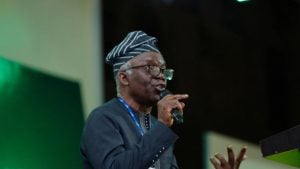
“As you are all aware, countries across the world, including major capitalist economies, such as the United States, Germany and France, subsidise not only fuel but also education, healthcare and other essential services.
“That is the reality today. A simple internet search will reveal announcements of various subsidies in different countries.”
The senior advocate argued that the Federal Government should be willing to reconsider its approach to fuel pricing and examine alternatives that could reduce the burden on citizens.
He said governments should be prepared to adjust their economic policies when circumstances change rather than present difficult measures as the only available option.
Falana also criticised the government’s position on petrol costs, particularly amid discussions about the landing cost of imported fuel.
He argued that the price at which petrol arrives in the country does not necessarily reflect what consumers eventually pay at filling stations because transportation and distribution expenses vary across locations.
“Here in Nigeria, with elections approaching, the government is telling us that the best it can offer is that the landing cost of fuel will be ₦1,350 per litre.
“When the government talks about landing cost, we must consider what that means for Nigerians in Abuja, Jos, Maiduguri and other parts of the country, where additional transportation and distribution costs may apply. That is what this administration has offered the Nigerian people.
“Among those seeking to take over power, only a few, including Omoyele Sowore and Donald Duke, have reportedly stated that, if given the opportunity, they would ensure that fuel sells for less than ₦500 per litre,” he said.
Another speaker at the event, Rashidat Adesina of the Joint Action Front, described the rise in petrol prices since the subsidy was removed in 2023 as a major setback for workers and poor households.
Adesina recalled that petrol previously sold for approximately ₦165 per litre before the policy change, after which prices rose to around ₦500 and later ₦600 per litre.
She said the prevailing prices cited at the gathering had reached between ₦1,350 and ₦1,400 per litre, depending on the location and filling station.
“We are now discussing prices of ₦1,350 to ₦1,400 per litre, depending on the location and filling station,” she said.
She challenged Nigerians to consider how workers could meet their daily needs when a significant portion of their earnings was threatened by rising energy and transportation costs.
“What does this mean for workers and poor Nigerians?” she queried.
Adesina explained that a worker earning the monthly minimum wage of ₦70,000 could purchase only 50 litres of petrol at ₦1,400 per litre, leaving no money from that calculation for food, rent, school fees, transportation or other necessities.
“The national minimum wage is ₦70,000 per month. At ₦1,400 per litre, an entire month’s minimum wage can purchase only 50 litres of petrol. That calculation does not include rent, school fees, food, transportation or other essential expenses,’’ she said.
She argued that the comparison illustrated the difficulties confronting low-income earners, especially those who depend on public transportation or petrol-powered vehicles to get to work and conduct their daily activities.
Adesina also referred to figures attributed to the National Bureau of Statistics concerning the country’s poverty threshold.
She said the reported figures reflected the vulnerability of households already dealing with rising prices and limited purchasing power.
“The consequences for ordinary Nigerians are severe. While workers and poor households struggle, sections of the business community continue to accumulate enormous wealth,” she said.
.