Fresh Details Emerge on Tinubu’s Alleged Deal With Wike Against Atiku, PDP
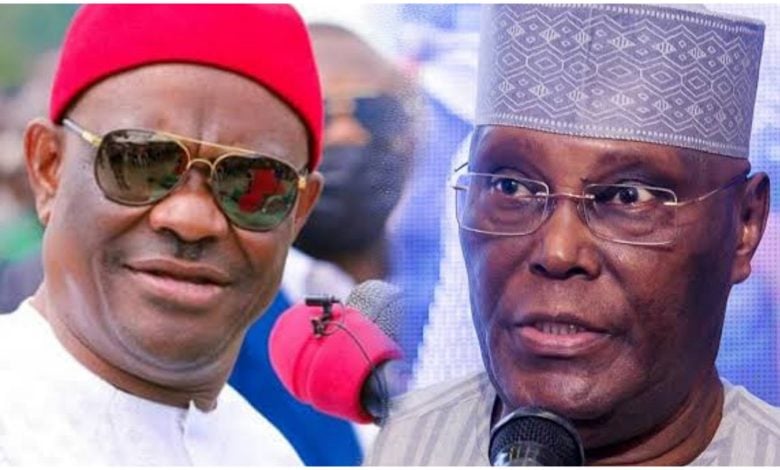
Fresh details have emerged about how President Bola Tinubu allegedly courted the Minister of the Federal Capital Territory (FCT), Nyesom Wike, then governor of Rivers State, in a secret political arrangement aimed at weakening former Vice-President Atiku Abubakar and frustrating the Peoples Democratic Party (PDP) ahead of the 2023 presidential election.
The revelations are contained in a new book titled Winning Formula: The Inside Story of Nigeria’s 2023 Presidential Election, written by journalist and founder of TheCable, Simon Kolawole.
The 296-page book, scheduled to hit the market on Monday, November 23, provides an account of the political manoeuvres, internal disagreements and strategic alliances that shaped the 2023 presidential election, which Tinubu won under the platform of the All Progressives Congress (APC).
One of the major revelations in the book is how Tinubu allegedly opened a secret channel of communication with Wike’s camp in June 2022, shortly after Atiku emerged as the PDP presidential candidate and picked Ifeanyi Okowa, then governor of Delta State, as his running mate.
Wike, who had lost the PDP presidential primary to Atiku, was reportedly dissatisfied with the decision to pick Okowa, having hoped to secure the vice-presidential ticket.
According to Kolawole’s account, Tinubu, who was then the APC presidential candidate, quickly recognised the growing division within the opposition party and moved to take advantage of the situation.
The book disclosed that Tinubu contacted an associate of Wike and requested a meeting to explore the possibility of a political understanding ahead of the 2023 election.
The APC candidate reportedly wanted Magnus Abe, a former senator and then APC governorship hopeful in Rivers State, to be part of the proposed meeting.
However, Wike allegedly had a major condition for any possible agreement. He wanted the APC to refrain from sponsoring a governorship candidate against his preferred successor in Rivers State.
Abe, who was also interested in becoming governor, was reportedly uncomfortable with an arrangement that could jeopardise his political ambition.
Despite the disagreement, the initial meeting between Tinubu and Wike’s representative eventually took place in June 2022 at the Lagos House in Abuja.
Kolawole’s book described the meeting as the beginning of a series of behind-the-scenes engagements between the two political camps, which continued as the disagreement between Wike and Atiku became increasingly bitter.
Following the initial contact, Wike and his political associates reportedly took direct control of the negotiations with Tinubu’s camp.
An expanded team comprising representatives of both sides was subsequently constituted, with regular meetings and strategy sessions held as the 2023 presidential election approached.
The book further revealed that Wike understood that confronting Atiku without the support of other influential politicians would limit the political impact of his rebellion, particularly to Rivers State.
Kolawole wrote that Wike knew he needed powerful allies to transform his disagreement with Atiku into a national political crisis for the PDP.
He subsequently rallied four other PDP governors: Samuel Ortom of Benue State, Ifeanyi Ugwuanyi of Enugu State, Okezie Ikpeazu of Abia State and Seyi Makinde of Oyo State.
The five governors became known as the G-5, a powerful bloc whose opposition to Atiku’s candidacy became one of the biggest challenges facing the PDP during the election campaign.
Two northern PDP governors, Ahmadu Fintiri of Adamawa State and Bala Mohammed of Bauchi State, initially associated with the group but later distanced themselves, reportedly amid political considerations within the northern wing of the party.
Meanwhile, other southern governors, including Udom Emmanuel of Akwa Ibom State, Godwin Obaseki of Edo State and Douye Diri of Bayelsa State, remained supportive of Atiku.
Emmanuel, who had also contested the PDP presidential primary, backed Atiku after losing the contest and reportedly entertained hopes of becoming his running mate.
With the G-5 firmly established, the disagreement within the PDP escalated into a major political confrontation that threatened the party’s chances in several states.
The governors repeatedly questioned the fairness of allowing another northerner to succeed President Muhammadu Buhari, who was completing his constitutionally permitted eight-year tenure.
They insisted that the PDP should have respected the principle of power rotation by zoning its presidential ticket to the South.
Their position placed Atiku, a northerner, under sustained pressure, particularly as the 2023 election campaign gathered momentum.
The book further revealed that while negotiations between Wike’s camp and Tinubu’s camp continued privately, the G-5 governors maintained a public campaign against Atiku and the PDP leadership.
Their strategy, according to the account, was to keep the PDP presidential candidate under pressure, question the legitimacy of his candidacy on the grounds of power rotation and weaken his appeal among southern voters.
The development created a serious headache for Atiku, who was forced to contend not only with opposition from the APC but also with a major rebellion within his own party.
For Tinubu, however, the growing division presented an opportunity to weaken his major political rival without having to lead the entire opposition campaign against Atiku himself.
The political crisis also exposed the deep divisions within the PDP following its presidential primary in May 2022, when Atiku defeated Wike to secure the party’s ticket.
Although Wike initially declared in August 2022 that he would not leave the PDP, his camp continued to demand the resignation of the party’s then National Chairman, Iyorchia Ayu, insisting that the party’s leadership structure was unfairly dominated by northerners.
The disagreement eventually prevented Wike from openly supporting Atiku during the presidential election.
Rather than campaign for his party’s presidential candidate, Wike and the G-5 governors maintained their opposition to Atiku’s candidacy, a development that further complicated the PDP’s campaign.
Tinubu eventually won the February 2023 presidential election and was subsequently inaugurated as president.
Wike later accepted an appointment as Minister of the Federal Capital Territory in Tinubu’s administration, despite being a prominent member of the PDP.