Gusau Officially Resigns As NFF President
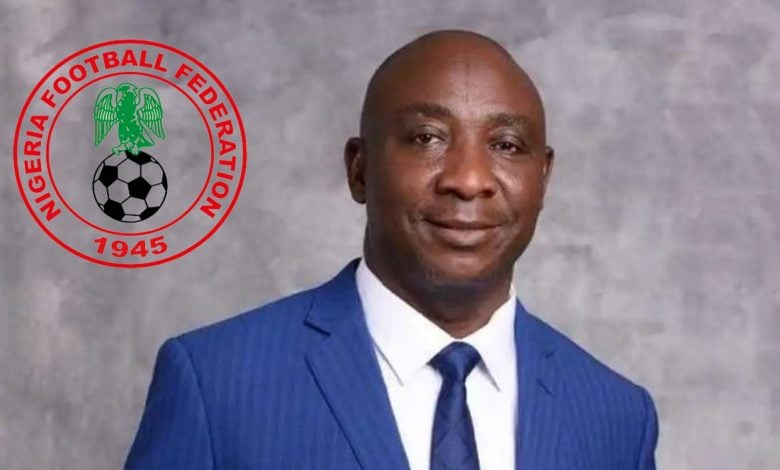
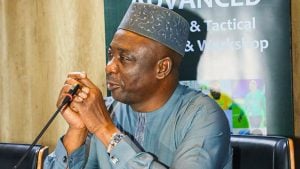
The President of the Nigeria Football Federation (NFF), Ibrahim Gusau, has officially resigned from office.
Gusau announced his decision during a press conference in Abuja on Thursday, confirming earlier reports that his administration was facing a major leadership crisis.
Board members of the Executive Committee joined in resignation.
We reported earlier that the NFF was scheduled for an emergency Congress meeting in Abuja, where football stakeholders were expected to deliberate on the development and determine the next steps for the federation.
The emergency meeting, which was scheduled for 12 noon on Thursday, was convened by members of the NFF Congress. Invitations were sent to state football association chairmen, club representatives, the Referees Association, Coaches Association, Players Union and other relevant stakeholders.
Attendance at the meeting was described as mandatory, highlighting the seriousness of the situation within the country’s football governing body.
Leadership Crisis
The emergency Congress was expected to consider the status of the NFF Executive Committee and Secretariat following the reported resignation of Gusau and several members of the board.
The Congress was also expected to examine provisions of the NFF statutes as well as relevant regulations of the Confederation of African Football (CAF) and FIFA in deciding how the federation should proceed.
Before Gusau’s confirmation on Thursday, reports had indicated that several members of his executive had either resigned or were considering leaving their positions.
The developments reportedly left eight of the 13 members of the NFF Executive Committee either resigned or no longer in their positions, raising concerns about the stability of the federation and its ability to function effectively.
Gusau was elected NFF president in September 2022 after winning the federation’s elective congress held in Benin City, Edo State.
Resignation Comes Amid Investigations
POLITICS NIGERIA reports that the Department of State Services (DSS) is reportedly examining documents connected to a N17 billion intervention fund approved by President Bola Tinubu in 2024 to settle outstanding salaries, bonuses and other financial obligations owed to Nigeria’s national teams.
A source familiar with the matter said the DSS had requested documents relating to the funds.
“It’s a normal thing for DSS to go through all documents relating to the funds released them,” the source said, dismissing suggestions that the exercise was intended to witch-hunt NFF officials.
The N17 billion intervention fund investigation is reportedly separate from another intelligence inquiry involving the DSS and the National Intelligence Agency over alleged contacts between some NFF officials and foreign nationals.
A security source described some of the alleged communications as “highly disturbing”, saying the investigation was concerned with issues considered to have broader national security implications.
The source also stressed that the two investigations should not be confused.
“It is true that President Bola Tinubu in 2024 approved N17 billion as a special intervention fund to help NFF clear outstanding payments owed to Nigeria’s national teams. However, that falls within the purview of the EFCC, not the DSS and NIA,” the source said.
Poor Results From National Teams
The development happens at a time when Nigerian football is facing growing concerns over the performances of several national teams.
The Super Eagles failed to qualify for the 2022 and 2026 FIFA World Cups, while the Super Falcons recently suffered the setback of missing qualification for the 2027 Women’s World Cup.
The Falcons had featured in every edition of the Women’s World Cup since the tournament began in 1991. That record came to an end after a difficult qualification campaign.
Nigeria’s women’s team lost 1-0 to Cameroon in the quarter-final of the 2026 Women’s Africa Cup of Nations, ending their title defence and forcing them into the World Cup qualification playoff route.
The Falcons subsequently lost 2-1 to South Africa’s Banyana Banyana in the playoff, confirming that Nigeria would not be present at the 2027 tournament in Brazil.
There have also been concerns about the fortunes of the country’s youth teams. The Golden Eaglets, despite Nigeria’s record of five FIFA U-17 World Cup titles, have failed to qualify for the last three editions of the competition.
The Dream Team, Nigeria’s U-23 side, has similarly struggled to maintain the standards associated with the team that won Olympic football gold at Atlanta 1996.
September Election Now in Focus
Gusau’s resignation has also thrown fresh uncertainty around the NFF’s planned elective Congress scheduled for September 27 in Lafia, Nasarawa State.
The election is expected to produce a new board for the federation, but the sudden leadership changes have raised questions about whether the process will go ahead as initially scheduled.
An insider had linked the wave of resignations to concerns surrounding the ongoing investigations and warned that the developments could affect the September election.
“That at least half of NFF executive have or are contemplating resignation, may not be unconnected with the fear of DSS and NIA probe, fuelling fears on the possibility of holding the NFF board election scheduled for September 27 in Lafia, Nasarawa State,” the insider said.