It’s Govt Property – Wike Warns ASUU, Others Over UNIABUJA Land Dispute
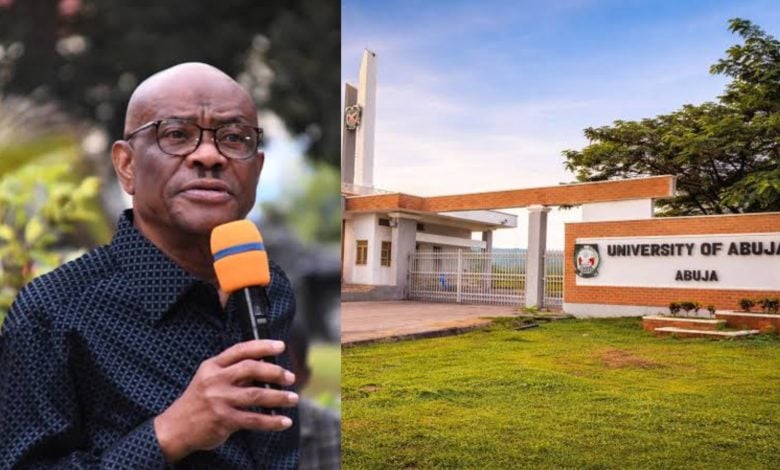
The Minister of the Federal Capital Territory (FCT), Nyesom Wike, has warned the Academic Staff Union of Universities (ASUU) and other workers’ unions at the University of Abuja (UNIABUJA) against protesting the government’s decision to reduce the institution’s land from 11,824.04 hectares to 4,685 hectares.
Wike, through his Senior Special Assistant on Public Communications and Social Media, Lere Olayinka, urged the unions to exercise restraint, arguing that unionism and activism should not be used to justify what he described as irresponsible conduct.
In a statement released on Thursday, Olayinka criticised the remarks of the union leaders, particularly ASUU Chairman, Professor Sylvanus Ugoh, describing their utterances as unbecoming of people working in an academic environment.
He also dismissed allegations by the Joint Action Committee (JAC) that Wike forged the 2016 report of the Joint Committee of the Federal Capital Territory Administration (FCTA) and UNIABUJA on Land and Sundry Issues.
The committee was established by former FCT Minister, Mohamed Musa Bello.
Olayinka said the allegation was reckless, adding that another committee was constituted on December 17, 2020, following a visit by the university’s management to the FCT minister on October 13, 2020.
According to him, the December 2020 committee recommended that the university should retain 1,922.66 hectares, while the remaining land should be developed for compatible uses, including institutional and research districts.
The committee based its recommendation partly on the National Universities Commission’s (NUC) recommended 100-hectare size for a university campus.
It also argued that reallocating the remaining land would help address continuous village expansion and prevent further encroachment on the university’s property.
Olayinka said the committee considered the land sufficient for the university’s academic activities, including demonstration farms and other auxiliary facilities.
He further disclosed that the 2016 committee had considered several issues raised by the university, including the issuance of Certificates of Occupancy for its main and mini campuses, properties in Kado and Jahi districts, settlements within the main campus and the reissuance of the title document for the mini campus.
Providing details of the findings of the December 2020 committee, Olayinka said 805.7 hectares of the university’s land had already been occupied by villages, while the Nigerian Army Welfare Limited Guarantee Housing Estate occupied 9.91 hectares.
He added that about 500 hectares had also been approved for a main sewage treatment plant.
Defending the FCT minister’s decision, Olayinka argued that Wike had the authority to allocate government land under the Land Use Act and did not require any committee report to exercise his powers.
He also questioned the involvement of workers’ unions in the government’s decision, insisting that the university and its land belonged to the government.
“Government established a university, gave land to it and later saw the need to reduce the land to what it opined can be better managed and utilized by the university, workers unions with primary responsibility of welfare of its members are protesting, what exactly is their business?” he asked.

Olayinka further argued that UNIABUJA had not utilised much of the land allocated to it despite operating for 38 years.
“Most importantly, after existing for 38 years, UNIABUJA has only utilized 1,426.67 hectares of land, with 49.56 hectares used for staff quarters. What then is the need for over 11,000 hectares of land when less than 1,500 hectares was utilized in 38 years?” he queried.
He also questioned why the university had allocated portions of its land to individuals and corporate organisations, including the Economic and Financial Crimes Commission (EFCC), if the land was still needed for its operations.
Olayinka maintained that the unions’ protest was misplaced, describing their involvement in the land dispute as strange, particularly at a time when universities across the world were adopting virtual learning.